January 30th, 2010 by James L. Sweaney, CGA, FGA. GG

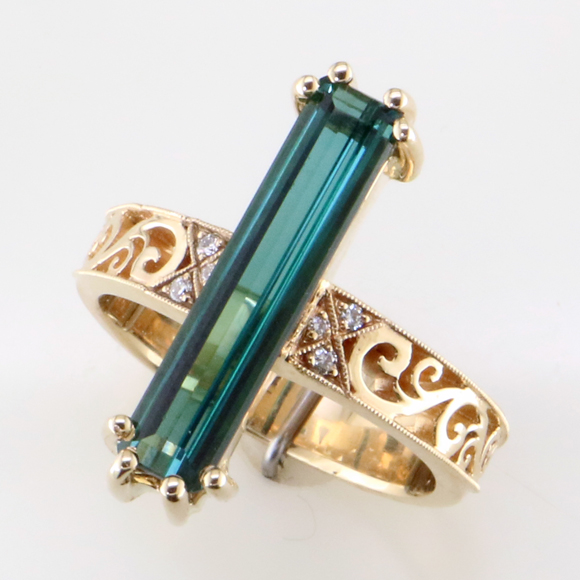
11.56 ct. Gem Spessartine Garnet
As we mentioned in our recent blog, we’re always excited to see the latest gem finds displayed at the upcoming Tucson gem shows. In recent decades Africa has been the biggest producer of wonderful new gemstones and gem materials.
The heavily mineralized Great Rift valley along the eastern side of the continent was one of the areas intensively prospected in the last half of the 20th century, resulting in such spectacular gem finds as the famous discovery of tanzanite deposits in the Merelani region of Tanzania and the wonderful green garnet, aptly named Tsavorite by its discoverer, Campbell Bridges, for the famous Tsavo game park of southern Kenya. Numerous sapphire, ruby, emerald, and alexandrite finds, along with many other less commercially important gems were also uncovered along the Rift region during this period
More recent finds in the western half of Africa have included the wonderful spessartine garnets of Namibia and Nigeria. These gems occur in a wonderful array of reds, red oranges, and oranges. Read the rest of this entry »
Posted in Gemstone of the Month, Gemstones, Jewelry Facts, Mardon Happenings | No Comments »
January 28th, 2010 by James L. Sweaney, CGA, FGA. GG

2 ct. Unheated Pigeon's Blood Ruby
Relating to our recent post about our quest for an unheated Pigeon’s Blood ruby entitled “A Seinfeld Holiday, Episode 2″ , we just received this very nice testimonial.
“Jim, thank you for your hard work and dedication in finding the perfect engagement stone for my fiancé – it has been a pleasure to do business with you over the last three months. Your professionalism and expertise stood out far in advance of the many other jewellers and dealers I have dealt with since I started looking for this unique gem. I had spent more than two months looking for such a stone before I found your website – I had previously spoken to some of London’s most prestigious jewellers and gem dealers with no luck. Your patience in helping us understand what we were really looking for and your consistent willingness to go the extra mile even when things got complicated were both greatly appreciated. We are both extremely happy with the purchase and we will treasure it forever. Thank you!”
Our Gemstone Brokering services consist of locating and facilitating the purchase of fine gemstones–and, as you can see from our story, we are able to do business internationally. Give us a call or contact us by email if you are looking for an exceptional gem– we specialize in exceptional!
Tags: Burma ruby, gemstone brokering, pigeon's blood ruby
Posted in Gemstones, Jewelry Services | No Comments »
January 27th, 2010 by James L. Sweaney, CGA, FGA. GG

Every year for the first two weeks in February, gem dealers and buyers from all over the world converge on the small desert city of Tucson, Arizona. The annual Tucson event has become the Mecca of colored stones, fossils and gem minerals where dealers display such sophisticated and extremely valuable gems like this matched suite of Imperial Jade– valued at over 100,000 dollars

Read the rest of this entry »
Tags: Deer Creek, fire agate, garnet, kashmir sapphire, moonstone, padparadscha sapphire, pigeon's blood ruby, spinel, Tucson Gem and Mineral Show
Posted in Gem Industry News, Gemstones, Jewelry Facts, Jewelry Services, Mardon Happenings | 1 Comment »
January 12th, 2010 by James L. Sweaney, CGA, FGA. GG

Fine Burma Rubies, Loose and Mounted
As promised, here’s a story that should get some chuckles– it’s an episode that turned out to be a long and winding road, so typical of the gemstone and jewelry business.
Several months ago, I was contacted by a gentleman residing in London, England. He was impressed by my series of blogs about Pigeon’s Blood Rubies and wanted to know if I could help him find an unheated ruby from Burma that would qualify as “pigeon’s blood” color. The gem would be used as the center of an engagement ring.
We offer gem brokering services for high end gemstones, so even though this person was overseas, I decided to give it a try– we are always looking to innovate and build our business, so why not go for the global market! Read the rest of this entry »
Tags: Burma ruby, gem broker, GIA, GRS, pigeon's blood ruby, Tom Lantos Act, unheated ruby
Posted in Custom Jewelry, Gemstones, Jewelry Services, Mardon Happenings | No Comments »
January 9th, 2010 by James L. Sweaney, CGA, FGA. GG

Gold for Recycling
True Story- One of our local police officers stopped by early this week with this group of assorted gold items she owned and wanted to sell– jewelry she no longer wore, broken pieces, etc. We sat down, I examined her gold for karat content and weighed it up.
Our offer for the lot that day was a little over $1000. Then she told me that she would be attending a “gold party” at a friend’s home later in the week. This was one of those “sponsored” events where the homeowner/party thrower invites friends and family to their home to visit a professional buyer and gets 10% of the take. I told her to go to the party and see what price her gold would bring, and please, to come back and let me know what they offered– I knew my offer would be more, but wanted to see by how much. Read the rest of this entry »
Tags: appraisals, cash4gold, gold parties, scrap gold calculator
Posted in Gem Industry News, Jewelry Services, Mardon Happenings, Uncategorized | No Comments »
January 2nd, 2010 by James L. Sweaney, CGA, FGA. GG

A Suite of Garnets
Yes, they are all garnets. The January birthstone is usually thought of as a dark red gemstone, but like the sapphire, garnet occurs in colors we don’t expect to see. In fact, garnets can be purple, red, orange, yellow, colorless or green, almost all the colors but true blue. There is even a garnet that changes color, like the alexandrite!
Garnets are actually a family of gems with six main “members”, all of which are silicate minerals that have similar chemistry and a similar crystal shape. Each member/type is a combination of two metal ions bound with oxygen to a silicate ion. Most garnets are mixtures of these various members, sort of like the genetic mixtures we see in living creatures.
Our suite contains examples of the four main garnet types used in jewelry, i.e. almandine, pyrope, grossular, and spessartine garnets. Over the next month, we’ll examine in more detail the wonderful garnet family, exploring it’s colors and the other characteristics that make it such a desirable gemstone. Keep your eye on the Mardon blog!
Tags: almandine, color change garnet, garnet, grossular, pyrope, spessartine
Posted in Gemstone of the Month, Gemstones, Jewelry Facts | No Comments »
December 23rd, 2009 by James L. Sweaney, CGA, FGA. GG
Keeping a sense of humor is so important during the current difficult business environment. We’ve had a couple of sales this holiday season that could be the basis for a sit-com script.
Last spring, a long time client wandered in to the shop and was mesmerized by a fine Cartier Tank Francaise wristwatch in our estate department. Her wistful looks and careful consideration of the watch as well as our conversation convinced me that she was going to buy the watch, or at least prod her husband into buying it for her– she had a birthday coming up. However, weeks and then months went by and we heard nothing. Read the rest of this entry »
Tags: Cartier watch, Estate Jewelry, Tank Francais
Posted in Estate Jewelry, Mardon Happenings | No Comments »
December 15th, 2009 by Scott C.
Sorry for the recent lack of updates! As you can probably imagine, December is by far our busiest season. We’ve been working hard this year on special orders, with quite a few already finished and several still in the process. We’re so busy doing things we haven’t had time to write about them, but don’t worry – we’ll have plenty of new pieces to share with you in the new year.
In the meantime, you can check out some of the jewelry we’ve recently added to the website. There are a number of new pocketknives, pens, and money clips from William Henry; as well as original designs from Kaye and Jenny Sweaney.


Finally, we have a new page detailing the life and times of our very own Jim Sweaney. You’ve read his blog articles, now find out what kind of experiences have helped him learn to write them!
Posted in Mardon Happenings | No Comments »
December 1st, 2009 by James L. Sweaney, CGA, FGA. GG

Pure Gold Cuff Bracelet
Published originally, Oct. 2009- We feel this information is more pertinent and valuable with the recent spike in gold prices.
“Record prices for gold, near $1200 per ounce, have many people considering selling gold they own, so the question is how to get the best price. Before taking action, it’s always wise to research and educate yourself.
The Consumer Reports Nov. 2009 issue, page 9, shows the results of their recent test of the gold buying market. They purchased identical 18K gold chains, each of which had about $70 worth of gold according to the market at the time of purchase. From last mid May to early July, they offered the chains to various gold buyers. Large “cash for gold” buying companies, like Cash4Gold, GoldKit, & GoldPaq paid the lowest, $7.60 to$20.59, 11 to 29% of the day’s market price, while other venues (like your friendly local jeweler!) paid $25 to $50, 35 to 70% of the gold value.
Before you recycle your gold, be aware of these facts about gold.
- Gold from mines and recycling is refined into pure gold. Refiners use heat and chemicals to separate the gold from impurities and other metals into gold that is at least 99.95% pure.
- Pure gold is designated 24K, meaning 24 parts out of 24 are gold, i.e. 100% gold.
- The gold used to make jewelry, dental fillings, and most gold coins is called karat gold.
- Karat gold is pure gold alloyed with metals like copper and nickel to harden or color the gold.
- Karat gold jewelry, dental fillings, and most gold coins are not pure gold– they contain a percentage of gold and a percentage of alloys.
- The percentage of gold in the alloy is determined by dividing the karat mark by 24. 18K means 18/24 , i.e. 75% of the item is gold.
- Gold coins generally range from 22K to 20K– 91.7% to 83.3% gold. Some gold coins are 24K
- Karat gold items manufactured in the USA before 1981 were allowed a 1/2 karat tolerance, so 14K gold was actually 13.5K, etc. Plumb gold laws enacted in 1981 erased that tolerance.
- 18K gold generally contains 75% gold. 14K gold generally contains 58.5 % gold. 10K gold generally contains 41.7% gold.
- Quality pieces, period or antique jewelry may have more value than just gold value.
Before you sell, know how the market works.
- Gold is always bought and sold by weight.
- Gold is weighed in the Troy system, in which 1 troy oz. = 20 pennyweights=31.105 grams.
- Karat gold buyers pay you for the actual gold content by weight– they will weigh your gold and calculate the actual gold content.
- The gold market changes daily, so the value of your gold changes daily. The gold market is the price of one troy ounce of 24K gold, set (fixed) each morning and afternoon at the London gold market.
- Karat gold buyers usually pay for your gold at a percentage of that day’s market value. Often, the more gold you sell at one time, the higher that percentage will be.
- It’s generally best to get immediate payment. You can easily sell your gold to local jewelers, pawn shops, and gold buying companies or persons. They accumulate larger lots, then sell to gold refiners.
- Many gold refiners do not buy small amounts of gold from private individuals. Gold refining is labor intensive and expensive, so refiners often prefer to buy larger amounts from middlemen.
- Karat gold buyers must accumulate enough gold to offset their refining losses and costs. The refiner pays them for the actual gold recovered (usually ~98%) less the costs of refining.
- Refiners take at least two days and as much as a week before they pay the seller. Gold buyers take the risk that the gold market will be lower when they sell it than when they buy it.
- Anyone who buys your gold is looking to make a profit– they try to sell it for more than they paid for it. But keep in mind, buyers must invest capital, bear risk, and pay refining and other costs.
So the question is really “What is a fair price for your gold?” In this writers opinion, a fair price is one that gives you reasonable value for your gold and allows the buyer a fair return on investment. We’ve always believed in the golden rule, treat others like you’d like to be treated, so 50/50 seems about right for starters. For bigger lots, you should get a bigger piece of the pie.
Mardon Jewelers buys gold to recycle and uses recycled Harmony gold in all the products we make. We are always happy to purchase your gold for recycling–just stop by the shop– we’ll weigh and value it for you at no charge. If you know the weight and karat of your gold, use our new Gold Value Calculator to get today’s value in real time.”
Mardon Jewelers also buys estate jewelry and diamonds.
Posted in Jewelry Facts, Jewelry Services | No Comments »
November 25th, 2009 by James L. Sweaney, CGA, FGA. GG
We’ve been very busy this month. With the renovation about completed, people are once again enjoying the Main Street Mall. With the Festival of Lights and the holidays eminent, anticipation and excitement are in the air. And, with Thanksgiving, with feasting and family, just think how blessed we are to live in this wonderful community and country. We thank all who have supported our business endeavors over the past difficult year, and hope you all have a joyful Thanksgiving.
Tags: Thanksgiving
Posted in Mardon Happenings | No Comments »