What is the Best Color for Blue Sapphire? Part 1
September 3rd, 2009 by James L. Sweaney, CGA, FGA. GG
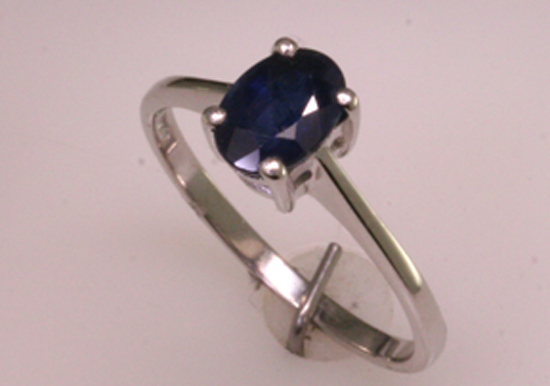
Classic Blue Natural Sapphire
Our clients often ask “What is the best color blue sapphire?” There are two answers– the obvious is that personal preference should dictate your color choice. Every person has unique abilities to perceive color, based on such things as age, health, culture and genetic gifts. Some people prefer light pastel colors, others prefer rich intense colors. The best color for you is the one that pleases, stimulates, or excites you!
The more complicated answer has to do with gem grading and market preferences, the physical characteristics of natural sapphires, the geological sources of sapphire including Ceylon, Burma, Kashmir, Madagascar, Thailand, Australia, and Montana, and the various methods of color enhancement and heat treatment of sapphire. We’ll begin by discussing gem grading and market preferences.
Color is a very complicated phenomenon in gemstones, presenting many challenges for gemologists and gem traders. We begin by grading the color of blue sapphires in terms of hue, tone, and intensity– for a thorough discussion of color grading gems, visit the color grading page at our Gallery of Gems.
Hue can be described as the name of a color, and relates to the actual wavelength of the visible light emanating from the gem. Some gem colors are described as two hues– such as green blue, signifying equal parts green and blue, or greenish blue for a color proportionately more blue than green. In grading gem colors, we normally emphasize the dominant hue by capitalizing it. For blue sapphire, the perfect hue would be simply Blue– not greenish Blue or violetish Blue. The hue of the sapphire below would be described as very slightly violetish Blue, while the hue of the second stone shown below and the blue sapphire ring shown at the beginning of this article is Blue.

very slightly violetish Blue sapphire color

Blue sapphire color
Tone is the relative position of a color on a 1 to 10 scale of light to dark. 1 being white, 10 being black. Blue sapphires can range from very pale blues that might be graded 2- 3 on the tonal scale to extremely dark blues that are graded 9. The 4.5 ct. Ceylon sapphire in the estate ring shown below is somewhat light in tone, ~ 4. The preferred tone for most blue sapphires that are used in jewelry is generally about 5 – 8.

blue Ceylon sapphire ring, tone ~ 4
`
Intensity is sometimes referred to as vividness or color saturation. There is an optimum combination of saturation and tone for each hue known as the gamut limit. Yellow colors are most vivid in the tonal range of 2-3, greens around 7, reds and blues around 7-8. Over about 85% tone, blue colors rapidly lose intensity– many commercial grade sapphires are so dark they appear “inky.” We grade intensity on a scale of 1 to 6, 1 being brownish or grayish colors, 6 being Vivid colors.
Intensity is the one characteristic that really separates the very best blue sapphires from all the rest. Stones that are truly “vivid” stand out– for example, one to two carat “vivid” stones may be double or triple the value of stones graded “strong.”
Overly Dark Blue Sapphire
So, in terms of gem grading and market valuation, the color of the highest grade and most expensive blue sapphires will have a hue of Blue, a tonal range of 7 to 8, and Vivid saturation. Although color is the dominant factor in grading and valuing blue sapphires, clarity and cutting are also very important, especially in those over one carat. The best blue sapphires have the perfect color, high transparency, and great craftsmanship of cutting.
In parts 2,3, and 4 of this series, we’ll discuss the role of the physical nature of sapphire, the geological distribution of sapphire, and the impact of enhancements on the color of blue sapphire.
If you’re in the market for this wonderful gem, stop by our shop, visit our Gallery of Gems, or give us a call — we’ll be happy to search the markets to locate your perfect blue sapphire!
Tags: Australia, blue sapphire, Burma, Ceylon, heat treatment, hue, Kashmir, Madagascar, Montana, saturation, Thailand, tone






December 23rd, 2009 at 9:27 am
I would like to get a valuation for some jewelry, 1920′ ex Greta Garbo blue sapphire on gold, a black saphire with dimonds plus several items that are no longer used.
Can you advise.
March 14th, 2011 at 8:49 am
I have a ring purchased by my grandfather from Greta Garbo’s auction when she left for America, it was bought by her lover Mauritz Stiller and consists of a Blue sapphire and diamonds.
Would you be able to inform me of a value and place to sell, as i never use it.
It is a perfect Sapphire set in red and white gold and is very beautiful.
00447866879914
Madeliene appelin.
March 18th, 2011 at 2:10 pm
I believe you queried my blog about this ring a while back. You should be able to sell your ring effectively in several ways.
First, to be able to realize the most money, you will need to get a good current Fair Market Value appraisal from a well qualified appraiser– Contact the Gemmological Assn. of Great Britain for a referral for someone local to you. It should include a good digital photograph, along with weight estimates and measurements for the gems, weight and metal quality, gem grading, especially for the sapphire. Add any written documentation you have showing the Garbo provenance– letter from your grandfather, bill of sale, etc. The Garbo provenance may or may not add value, depending on how strong it is and the quality of the ring.
Once you have a good idea of value, you can look at the markets available to you.
The highest value you could get would be to sell to an interested private party. Price would be negotiable, exposure would be based on the effort and expense you put into it. You might be able to negotiate between 50 and 100% of Fair Market Value ( Appraisal)
Another market would be something like Ebay, but you need to know what you are doing here. It’s important to make sure you get paid!
If the value is over $10.000 US, you might look at an auction house like Christy’s or Sotheby’s. They do charge a seller’s premium, usuallly about 10%.
An immediate market would be a legitimate respected jeweler who buys estate jewelry. Expect to get about 25 to 50% of Fair Market Value, depending on the ring.